Research
Official Sources on Dollar Access
A guide to official IMF, World Bank, and central-bank sources on dollar access, remittances, inflation, and financial inclusion.
Nobody has to take Arca's word for it. The institutions that govern the global money system have already written the problem down. Here is what their own numbers say.
01 / The access gap
Most people without a bank account are already carrying the thing that could give them one.
02 / The flows
Dollars already move home across borders at a scale national accounts have to track line by line.
$ 685 B
in remittances reached low- and middle-income countries in 2024
World Bank, Migration and Development Brief 40$ 61.8 B
of that reached Mexico alone in 2025, across 155.7 million transfers
Banxico, SIE table CA1103 / The pressure
Where local money loses value or foreign exchange is hard to reach, people look for a way to hold dollars.
117.8 %
consumer inflation in Argentina during 2024, before it cooled to 31.5% in 2025
INDEC, Argentina04 / The response
When people reach for a way to hold dollars, more of them now find one in digital form.
99 %
of the value held in dollar-backed digital money is linked to the US dollar
IMF, Finance & Development, 202547 %
of digital-dollar users surveyed in emerging markets hold them to save in dollars
Castle Island Ventures and Visa, 2024 surveyFrom the record to your hand
The data describes the problem. Holding dollars is the simple part.
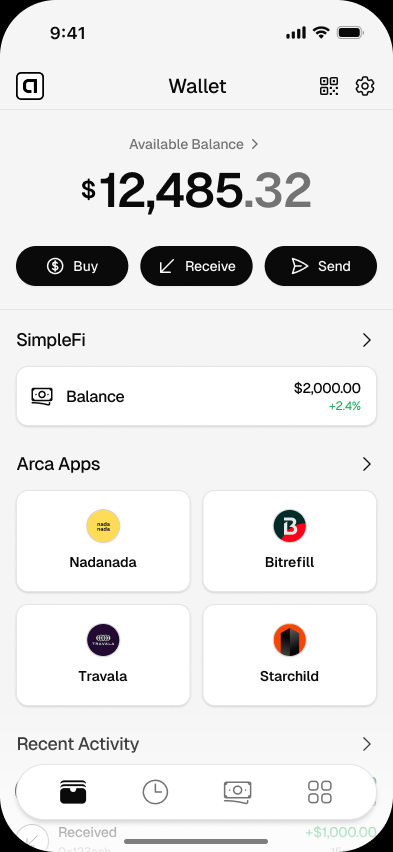
Arca lets you hold and send dollars straight from your phone. No US bank account, no branch visit. Your balance stays yours.
- Keep your money in dollars
- Send to any phone in seconds
- You hold the keys
Arca will not fix inflation or remove country risk. It gives you one simple way to hold dollars when local money is hard to use.
Full source guide
Every figure above traces back to a public record. The guide below shows exactly where each one lives, and how to read it for yourself.
Official sources on dollar access
Dollar access is not a mystery topic. The evidence is already public, but it is scattered across long reports, central-bank tables, statistical portals, and country annexes.
This page is a guide to those official sources. It does not create an Arca index. It does not assign scores. It does not rank countries. It points readers to the primary records that show how inflation, foreign-exchange restrictions, remittances, banking access, and phone-based financial access appear in official data.
Start with the IMF
The IMF World Economic Outlook is the starting point for macro conditions. It gives country-level inflation, output, current-account, and other economic indicators that help explain pressure on local savings.
The IMF Financial Access Survey is useful for financial-access questions. It tracks access points such as bank branches, ATMs, accounts, and related indicators across countries.
The IMF Annual Report on Exchange Arrangements and Exchange Restrictions is the deeper source for foreign-exchange restrictions, capital controls, payment restrictions, and exchange arrangements.
IMF Article IV reports then add country context. They often explain reserves, inflation, exchange-rate policy, foreign-exchange market depth, financial-sector risks, and the exact constraints policymakers are seeing.
Then read the national central bank
Central banks usually hold the most direct local evidence. The right report depends on the country.
| Country or corridor | Official source path | What it helps prove |
|---|---|---|
| Argentina | BCRA banking and monetary reports | Foreign-currency deposits, credit, liquidity, and the domestic role of dollars |
| Nigeria | IMF Article IV plus CBN reserve and FX-market materials | Reserve definitions, inflation pressure, FX-market structure, and access constraints |
| Mexico | Banxico remittance tables | Remittance income, transaction count, average transfer size, channel, and geography |
| Philippines | BSP balance-of-payments releases | Overseas worker remittances and the household role of dollar inflows |
| Brazil | Banco Central do Brasil Pix statistics | How fast phone-native payment rails can become everyday financial infrastructure |
These sources are useful because they are not marketing copy. They are the records governments, central banks, and international institutions already publish.
What to look for in each official source
Official data becomes useful when it answers a practical question.
| Source signal | Where it usually appears | Practical question |
|---|---|---|
| Inflation pressure | IMF WEO, national statistics, central-bank reports | Are local-currency savings losing value quickly? |
| Exchange restrictions | IMF AREAER, Article IV reports, country annexes | Is access to foreign exchange limited, delayed, or regulated? |
| Remittance dependence | Central-bank remittance and balance-of-payments reports | How much household money enters through cross-border transfers? |
| Banking access | IMF FAS, World Bank Global Findex, local access reports | Can people use mainstream financial services without friction? |
| Phone-based access | World Bank Findex, payment-system reports, central-bank payment data | Are phones already part of the financial-access story? |
| Reserve and liquidity notes | IMF staff reports, central-bank reserve publications | Is official FX liquidity easy to understand, or does it need context? |
This is why the research pages in this collection cite reports directly instead of relying on broad claims about instability.
World Bank financial-access sources
The World Bank Global Findex is one of the strongest sources for financial inclusion. Its 2025 release reported that 79% of adults worldwide now have a financial account, up from 74% in 2021, yet 1.3 billion adults still lack access to financial services. The World Bank also reported that about 900 million of those adults have a mobile phone, including 530 million with smartphones.
That source matters for Arca because dollar access is not only a foreign-exchange question. It is also an access question. A tool that requires a bank branch, wire transfer, or US bank account does not reach everyone who needs to hold or receive dollars.
For the full country-by-country directory, with live links to every central bank and report, see the Dollar Access Data Center.
The global picture in a few numbers
A handful of official figures frame why dollar access keeps coming up.
| Figure | What it measures | Source |
|---|---|---|
| 1.3B | adults still without financial services | World Bank, Global Findex 2025 |
| $685B | remittances to low- and middle-income countries in 2024 | World Bank, Migration and Development Brief 40 |
| $129B | the largest single recipient, India, in 2024 | World Bank, Migration and Development Brief 40 |
| 6.36% | average global cost to send $200, against a 3% 2030 target | World Bank, Remittance Prices Worldwide |
| 99% | of dollar-backed digital money is linked to the US dollar | IMF, Finance & Development, 2025 |
After India, the largest 2024 remittance recipients were Mexico at $68 billion, China at $48 billion, the Philippines at $40 billion, and Pakistan at $33 billion. In the most dependent economies, such as Tajikistan and Tonga, remittances are worth a third or more of GDP.
Country pages built from official records
The first pages in this collection each begin with a primary source.
| Page | Official source anchor | Why it matters |
|---|---|---|
| IMF dollar restrictions | IMF AREAER | Shows where exchange restrictions and capital controls are documented |
| Nigeria reserve footnote | IMF Nigeria Article IV report | Shows how reserve definitions, inflation, and FX-market depth shape dollar access |
| Argentina dollar access ledger | IMF Argentina reports and BCRA banking reports | Connects official restrictions with formal dollar deposit activity |
| Mexico remittance map | Banxico remittance tables | Shows the scale and structure of dollar flows into Mexican households |
| Philippines remittance engine | BSP balance-of-payments releases | Shows the role of overseas worker remittances in household finance |
What this means for people saving money
Official data is not enough by itself. People still need simple explanations.
If inflation is high, a household may want part of its savings in dollars. If remittances are expensive, a family may want clearer costs and better control over when money is converted. If banking access is limited, a phone-based wallet can matter more than another branch-based product.
That is where digital dollar wallets become relevant. They offer a phone-based way to hold dollar value without needing a US bank account.
Arca can help people hold and send dollars. It cannot eliminate country risk, promise returns, or replace every local payment need. The official sources help define the problem clearly so the product connection stays honest.
Sources
- IMF, World Economic Outlook, April 2026
- IMF, Financial Access Survey
- IMF, Annual Report on Exchange Arrangements and Exchange Restrictions 2023
- World Bank, Global Findex 2025 press release
- World Bank, Global Findex 2025 data download
- World Bank, Migration and Development Brief 40
- World Bank, Remittance Prices Worldwide
- IMF, Finance & Development: stablecoins and dollar dominance, 2025
Hold dollars from your phone.
Arca gives people a simple way to hold and send digital dollars when local money systems are hard to use.
Get started with ArcaMore research
Argentina's Official Dollar Access Ledger
IMF and BCRA data show how Argentina restrictions, dollar deposits, and household dollar demand connect to digital dollar access.
Currencies Losing Value Against the Dollar (2021-2026)
A neutral data reference showing how selected currencies moved against the US dollar over five years, with approximate exchange rates and the value each lost.
IMF Dollar Restrictions by Country: AREAER Explained
See what the IMF AREAER tracks about foreign-exchange restrictions, capital controls, and access to dollars by country.